
TradeHub 21 Review: Ramp-Up B1 Industrial Units in Jurong East — Investability, Pricing and FAQs
An engineering-report style review of TradeHub 21 at 8 Boon Lay Way: insider investability rating, spec facts, ramp-up unit types, investment pros and cons, and 14 detailed FAQs covering stamp duties, GST, yields and lease decay.
Insider Investability Rating
78 / 100
A well-configured ramp-up B1 asset beside the Jurong Lake District growth engine, with strong occupier fundamentals offset by a decaying lease and abundant intra-building supply.
PSF sits mid-band for western ramp-up stock — fair value given the location, though not the bargain tier.
Ramp-up access, regular unit layouts and the Jurong East address attract a wide occupier spectrum.
The Jurong Lake District masterplan and Jurong Region Line progressively deepen the tenant catchment.
Good liquidity at realistic pricing, but the large strata pool and shortening lease demand disciplined exits.
Project Overview
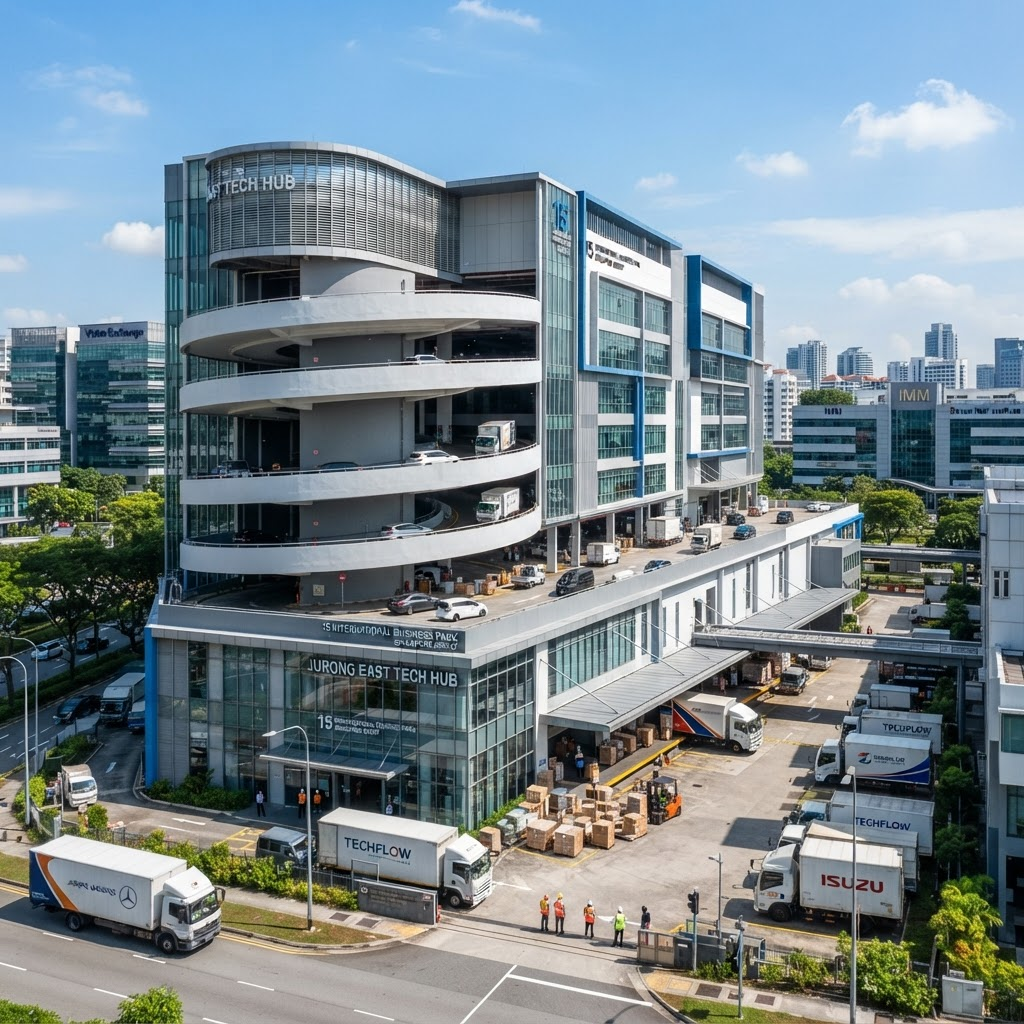
TradeHub 21 is a large-scale strata-titled B1 industrial development at 8 Boon Lay Way, on the doorstep of Jurong East's commercial core. Completed in the mid-2000s as one of the west's pioneering ramp-up projects, it stacks vehicle-accessible industrial floors above a landscaped frontage, giving hundreds of SMEs direct-drive loading in a location most industrial estates cannot match. Its position beside the expanding Jurong Lake District — Singapore's largest business district outside the city centre — anchors both its occupier demand and its longer-term investment story.
- Address
- 8 Boon Lay Way, Singapore 609964
- District / Zoning
- D22 · B1 (Light Industrial)
- Tenure
- ≈60-year leasehold from 2003
- Built Form
- 6-storey ramp-up industrial complex
- Completion
- ≈2006
- Units
- ≈800+ strata units
- Transacted PSF
- ≈S$380 – S$560 psf
- Indicative Rents
- ≈S$1.40 – S$2.10 psf/month
- Nearest MRT
- Chinese Garden (EW25), ≈8 min walk
- Expressway
- PIE ≈2 min · AYE ≈6 min
Location & Connectivity
TradeHub 21 fronts Boon Lay Way directly, with the Pan Island Expressway on-ramp roughly two minutes from the exit barrier — a genuine logistics advantage for operations running daily deliveries across the island. The Ayer Rajah Expressway is a short drive south, linking the building to the one-north and Alexandra business corridors, the port and, in time, the consolidated Tuas Mega Port. Few strata industrial addresses combine this expressway geometry with an MRT station within walking distance.
Chinese Garden MRT on the East–West Line is about eight minutes on foot, and Jurong East interchange — with its retail cluster of JEM, Westgate and IMM — is one stop away or a short bus ride. The coming Jurong Region Line will further web the surrounding estates together. For occupiers, this means staff can commute without cars, an underrated recruiting advantage for workshop and back-office hybrid teams.
The immediate precinct mixes industrial, big-box retail and institutional uses: IMM's warehouse-retail crowd, the international business park across the PIE, and Ng Teng Fong General Hospital nearby. This diversity keeps daytime footfall and service demand steady, benefiting the food and amenity units within the development.
Building & Facilities
The development's defining feature is its full ramp-up circulation: a wide vehicular ramp serves every industrial floor, so 20-footer and smaller lorries can drive directly to unit doorsteps on upper levels. Floor loading of ≈15 kN/m² on typical levels and ceiling clearances of ≈6 metres on selected stacks support racking, small cranes and approved mezzanines. Dedicated loading bays, container parking and generous driveway widths reduce the peak-hour queuing that plagues older estates.
Common amenities include a canteen cluster, ground-floor food units, passenger and cargo lifts supplementing the ramp, ample lorry and car parking, and 24-hour access with security. The MCST maintains the building to a standard visibly above the average for its age band; management fees are moderate, and the sinking fund has supported cyclical repainting and services upgrading. The overall impression is of a working asset that has been kept commercially presentable.
Unit Types & Floor Plans
Typical strata units range from ≈1,300 to 2,600 sq ft, larger on average than older plazas like WCEGA — a deliberate design choice that suits businesses combining storage, light production and a small office front in one footprint. Layouts are predominantly regular rectangles with roller-shutter entrances sized for direct vehicle backing, attached toilets in most stacks, and window units along the perimeter that admit natural light for office corners.
Corner and double-frontage units carry premiums for manoeuvring space and signage; a limited number of combined units exceed 5,000 sq ft for larger operators. Because every industrial floor is ramp-served, the traditional ground-floor premium is flatter here than in lift-only buildings — upper ramp floors trade at modest discounts rather than steep ones, which supports more uniform rental performance across the stack.
Who This Suits
TradeHub 21 suits owner-occupier SMEs that need genuine drive-up logistics with a presentable Jurong East address: distributors and wholesalers, e-commerce fulfilment operations, precision engineering and light assembly, building-services contractors, and showroom-workshop hybrids serving western Singapore. It equally fits investors targeting the ≈4.5%–6% gross yield band who want exposure to the Jurong Lake District growth narrative without paying business-park pricing. It is less suitable for heavy manufacturers needing B2 zoning, image-led corporate offices, or buyers requiring maximum remaining tenure for long-dated financing.
Investment Case: Pros vs Cons
Pros
- Full ramp-up access flattens the floor-premium curve and broadens tenant demand
- Two-minute PIE access plus walkable MRT — rare combination for strata industrial
- Beside the Jurong Lake District masterplan, Singapore's largest decentralised CBD
- Larger average unit sizes suit consolidated storage-production-office operations
- Well-run MCST with building condition above its age band
- No ABSD on industrial property for most buyer profiles
Cons
- Decaying ≈60-year lease from 2003 progressively tightens financing terms
- Higher PSF than older western plazas narrows the value gap
- 800+ strata units mean constant internal competition on resale and leasing
- GST applies on purchase from GST-registered sellers
- B1 zoning excludes heavier processes and retail-facing trades
- Mid-2000s services require rising maintenance provisions over time
Frequently Asked Questions
What can I legally operate in a B1 unit at TradeHub 21?
B1 zoning permits light industrial activities with a nuisance buffer of 50 metres or less: light manufacturing and assembly, repair and servicing workshops, printing, packing and e-commerce fulfilment, research and development, and warehousing ancillary to your own business. At least 60% of the floor area must generally serve the approved industrial use, with ancillary offices capped at 40%. Pure offices, retail shops, entertainment and residential uses are prohibited, and heavier processes involving significant emissions or noise belong in B2 premises. TradeHub 21's MCST also applies house rules on trades like vehicle spraying. Verify your intended use with URA and the management before committing to a purchase or lease.
Can foreigners buy a unit in TradeHub 21?
Yes. Industrial property falls outside the Residential Property Act, so foreign individuals and foreign-incorporated companies may buy strata units at TradeHub 21 freely, without government approval and without nationality-based stamp duties. Many foreign buyers nonetheless structure the purchase through a Singapore private limited company for GST recovery, simpler local banking and liability separation. Note that financing for foreigners is typically more conservative: banks may cap loan-to-value ratios lower than for locals and price margins slightly higher, and some lenders decline shorter-lease industrial assets for offshore borrowers altogether. Obtain in-principle approval before committing, and budget conservatively for equity of 30–40% of the purchase price.
Does ABSD apply when buying here?
No. Additional Buyer's Stamp Duty is levied only on residential property in Singapore. TradeHub 21 is zoned B1 industrial, so no ABSD is payable — regardless of your nationality, the number of properties you already hold, or whether you buy as an individual, company or trust. This exemption is a key structural reason investors who have used up their residential capacity rotate into industrial and commercial assets. Your transaction costs will instead comprise Buyer's Stamp Duty on the higher of price or market value, legal fees, and GST where the seller is GST-registered. Model all three before benchmarking returns against residential or commercial alternatives.
Is Seller's Stamp Duty (SSD) payable on industrial property?
Yes. Industrial property carries its own SSD schedule, introduced in January 2013 to damp speculative flipping of strata factories. Sell within the first year of purchase and SSD is 15% of the price or market value, whichever is higher; within the second year it is 10%; within the third year 5%; and after three full years of ownership nothing is payable. The clock runs from the purchase date on the sale and purchase agreement. Owner-occupiers and medium-term landlords are rarely affected, but buyers acquiring ahead of uncertain expansion plans should stress-test scenarios where they must exit early, because SSD comes off gross proceeds regardless of profit.
How much Buyer's Stamp Duty (BSD) will I pay?
BSD on non-residential property is tiered: 1% on the first S$180,000, 2% on the next S$180,000, 3% on the next S$640,000, 4% on the next S$500,000 and 5% above S$1.5 million. A representative TradeHub 21 unit of ≈1,800 sq ft transacting at ≈S$850,000 attracts BSD of roughly S$20,100 — about 2.4% of the price. The duty is assessed on the higher of the consideration or market value and must be stamped within 14 days of signing in Singapore (30 days if executed abroad). Your conveyancing lawyer files through the IRAS e-stamping portal, and the certificate is required before lodging the transfer.
Does GST apply to a purchase at TradeHub 21?
It depends on the seller. If the vendor is GST-registered — typical where the unit is company-held — GST at the prevailing 9% applies on the purchase price. A GST-registered buyer can generally recover it as input tax, so many investors buy through a GST-registered Singapore entity to convert the tax into a temporary cash-flow item rather than a sunk cost. Purchases from non-registered individual sellers normally carry no GST. Where both parties are GST-registered and the unit is sold tenanted, the deal may qualify as a transfer of a going concern and be zero-rated. Engage your accountant early — registration timing relative to completion matters.
Should my business buy or lease here?
Weigh horizon against flexibility. Buying at ≈S$380–S$560 psf converts rent of ≈S$1.40–S$2.10 psf monthly into mortgage amortisation, locks occupancy cost against inflation, and frees you to fit out heavy racking or mezzanines without landlord consent. The trade-offs are capital locked in a depreciating leasehold, SSD exposure inside three years, and slower relocation if the business outgrows the space. Leasing needs only a two-to-three-month deposit and suits fast-scaling or uncertain operations. As a rule of thumb, businesses confident of seven or more years of occupation, whose mortgage payment approximates market rent, usually come out ahead owning.
What rental yield can investors expect?
At entry pricing of ≈S$380–S$560 psf and achievable rents of ≈S$1.40–S$2.10 psf per month, gross yields typically compute to ≈4.5%–6%. Net yield deducts management fees, property tax at the 10% non-residential rate on annual value, insurance and vacancy allowance — realistically landing most units at ≈3.5%–4.8% net. Ramp-front and corner units command the upper rent band and re-let fastest; interior upper-floor units are cheaper to buy and yield comparably on paper, but budget longer marketing periods in soft patches. The Jurong Lake District build-out is the medium-term swing factor that could push effective rents above today's band.
How does the building's age and lease decay affect value?
TradeHub 21's ≈60-year lease from 2003 leaves roughly 37 years at the time of writing. Leasehold industrial values do not decline linearly: the discount deepens as the balance falls below key financing thresholds — banks progressively shorten loan tenures once the remaining lease dips under about 30 years, and buyer pools thin accordingly. Against this, the building's mid-2000s construction is younger than much competing western stock, and its maintained condition supports rentability, which cushions income even as capital value plateaus. Investors should model returns primarily from yield rather than appreciation, and plan exits before the lease crosses the 30-year psychological line.
What are the realistic en-bloc prospects?
Slim in any actionable timeframe. Collective sales of strata industrial developments are rare because the numbers seldom work: with 800+ units, securing the required 80% consent by share value and strata area is a formidable coordination exercise, and a developer would also need to top up the lease with SLA at substantial cost before redevelopment. The site's B1 plot ratio is already substantially utilised, limiting intensification upside. The Jurong Lake District narrative periodically stirs speculation, but buyers should treat en-bloc as a lottery-ticket bonus, not an investment thesis. Value here is earned through rental income and disciplined entry pricing, not redevelopment arbitrage.
What parking and loading provisions does the building offer?
The core advantage is the ramp itself: every industrial floor is directly accessible to lorries up to roughly 20 feet, so most units load and unload at their own doorstep rather than queuing for shared bays. Supplementing this are ground-level loading bays with dock levellers for container operations, cargo lifts for palletised goods, and season plus hourly parking for cars and lorries across surface and covered decks. Visitor parking is generally available outside peak mid-morning hours. Businesses running frequent third-party container deliveries should still verify height clearances and container-parking allocations with the MCST, as house rules govern heavy-vehicle dwell times.
How high are MCST management fees?
Management contributions at TradeHub 21 are levied by share value and typically work out to ≈S$0.25–S$0.40 psf per month for standard units — moderate for a ramp-up development with 24-hour security, maintained ramps and serviced loading infrastructure. The fee funds security, cleaning, lift and ramp maintenance, landscaping, insurance and the sinking fund for cyclical works such as repainting and services replacement. Ramp-up buildings cost more to maintain than lift-only blocks because the drive aisles and ramps are common property, so compare fees against equivalent ramp-up stock rather than basic flatted factories. Request the latest AGM minutes and audited accounts during due diligence to spot upcoming special levies.
How liquid is resale at TradeHub 21?
Reasonably liquid by strata industrial standards, but price discipline decides outcomes. The development's size means several units are usually listed concurrently, giving buyers comparison power; realistic sellers of ramp-front, corner or renovated units typically transact within three to six months. The buyer pool spans owner-occupier SMEs upgrading from leased premises, yield investors, and occasionally family offices assembling industrial income portfolios. Liquidity will gradually tighten as the lease shortens and financing terms compress, so long-hold investors should map their exit window deliberately. Units priced against recent caveat data — not against optimistic asking prices — consistently clear the market fastest.
Which business types thrive here in practice?
The strongest fits are operations that monetise the ramp and the address together: regional distributors and wholesalers running daily van fleets, e-commerce brands with pick-pack-ship floors, precision engineering and electronics assembly, medical and lab-equipment suppliers serving the nearby hospital cluster, renovation and building-services contractors, and showroom-workshop hybrids for furniture, lighting or fitness equipment. Food manufacturing is feasible only in approved units with proper exhaust and grease-trap provisions. Businesses that underperform here are walk-in retail concepts, prestige client-entertainment offices, and heavy fabricators needing B2 zoning, cranes or open-yard storage better found in Tuas, Kranji or Senoko.
This article is provided for general information only and does not constitute financial, legal or investment advice. Figures marked with "≈" are reasonable estimates based on publicly observable market data at the time of writing and may not reflect current transacted values. Prospective buyers and tenants should conduct independent due diligence, verify zoning and permitted use with the relevant authorities, and seek professional advice before entering into any transaction.
Have Questions About This Topic?
Speak with an advisor about anything covered in this article.