
WCEGA Plaza Review: B1 Industrial Units in Bukit Batok — Investability, Pricing and FAQs
An engineering-report style review of WCEGA Plaza at 1 Bukit Batok Crescent: insider investability rating, spec facts, unit types, investment pros and cons, and 14 detailed FAQs covering stamp duties, GST, yields and lease decay.
Insider Investability Rating
74 / 100
A functional, well-located B1 strata industrial asset with accessible pricing and steady owner-occupier demand, tempered by lease decay and a competitive resale field.
Entry PSF sits well below newer B1 developments in the west, offering value for cost-conscious occupiers.
Broad appeal to SMEs, trades and light manufacturers, though the building competes with many similar strata plazas nearby.
Jurong Lake District growth and tight islandwide B1 supply support medium-term demand for functional space.
Resale liquidity is adequate at realistic pricing, but the shortening lease will progressively narrow the buyer pool.
Project Overview
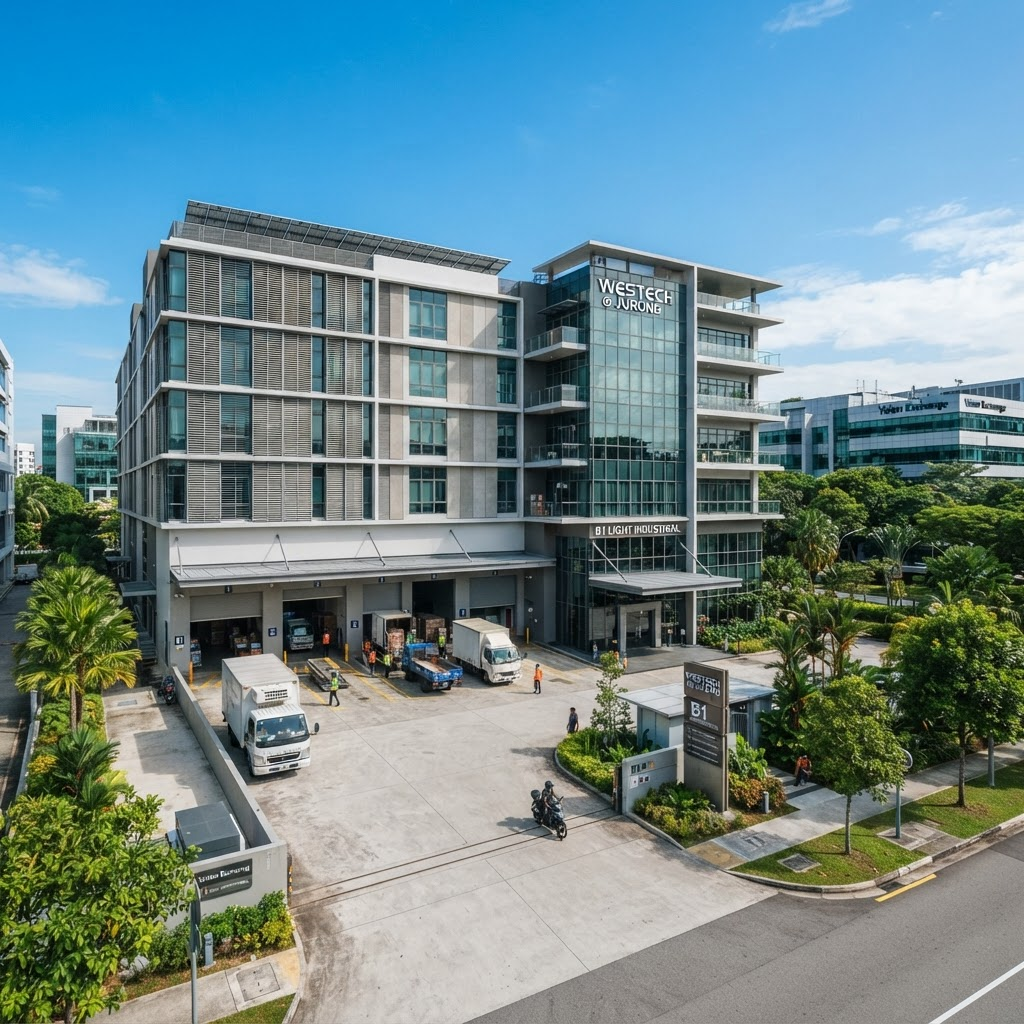
WCEGA Plaza is an eight-storey strata-titled B1 industrial development on Bukit Batok Crescent, in the established Bukit Batok industrial estate on Singapore's west side. Completed in the late 1990s alongside the adjoining WCEGA Tower, the plaza offers a large pool of compact factory and workshop units that have long served small and medium enterprises, vehicle-related trades, storage operators and light manufacturers. Its combination of accessible pricing, drive-up convenience and proximity to the Pan Island Expressway has kept it consistently occupied through multiple market cycles.
- Address
- 1 Bukit Batok Crescent, Singapore 658064
- District / Zoning
- D23 · B1 (Light Industrial)
- Tenure
- ≈60-year leasehold from 1994
- Built Form
- 8-storey ramp-up industrial plaza
- Completion
- ≈1998
- Units
- ≈600+ strata units
- Transacted PSF
- ≈S$300 – S$480 psf
- Indicative Rents
- ≈S$1.20 – S$1.90 psf/month
- Nearest MRT
- Bukit Gombak (NS3), ≈12 min walk
- Expressway
- PIE ≈3 min · KJE ≈6 min
Location & Connectivity
WCEGA Plaza sits at the junction of Bukit Batok Crescent and Bukit Batok Street 23, inside one of the west's longest-established light industrial clusters. The Pan Island Expressway is roughly three minutes away by car, putting Jurong, Tuas, the city fringe and the future Tuas Mega Port catchment within practical daily-logistics reach. The Kranji Expressway adds a second artery toward Woodlands and the Causeway for businesses with Malaysia-linked supply chains.
Public transport access is genuinely usable rather than nominal: Bukit Gombak MRT on the North–South Line is about a twelve-minute walk, and multiple bus services along Bukit Batok East Avenue 3 connect to Bukit Batok and Jurong East interchanges. For staff-dependent operations such as workshops, showrooms-cum-offices and small assembly lines, this materially widens the hiring pool compared with more remote estates like Tuas or Senoko.
The surrounding estate mix — motor workshops, building-services contractors, food-adjacent trades and self-storage — creates a practical ecosystem where suppliers, sub-contractors and customers are often within a short drive.
Building & Facilities
The plaza is configured as a ramp-up development, with vehicular access to upper floors — a feature that remains one of its strongest practical selling points. Units on ramp-accessible levels allow vans and small lorries to load directly at the door, which vehicle workshops, equipment traders and storage users value highly. Floor loading is suited to light industrial use, and ceiling heights across most stacks accommodate mezzanine storage subject to approval.
Common facilities include passenger and cargo lifts, surface and multi-storey parking, loading and unloading bays, and a selection of ground-floor food and amenity units serving the working population. Management is run by the MCST, with maintenance fees kept moderate relative to newer developments — a recurring cost advantage for thin-margin operations. The building shows its age in places, but ongoing cyclical upgrading works have kept core services functional.
Unit Types & Floor Plans
The strata mix is dominated by compact units of roughly 700 to 1,600 sq ft, with a smaller number of combined or corner units reaching 2,000 to 4,000+ sq ft. Typical layouts are simple rectangles with a single roller-shutter or standard entrance, an attached toilet in many stacks, and clear internal spans that fit racking, benches or partitioned office fronts with minimal wastage.
Ground-floor and ramp-front units command the highest PSF within the building because of direct vehicle access and signage visibility; upper-floor lift-served units trade at a meaningful discount and suit storage, e-commerce fulfilment and quieter workshop uses. Buyers should verify permitted use with the MCST and URA before committing, as B1 zoning excludes heavier processes and most retail-style frontage activity.
Who This Suits
WCEGA Plaza fits owner-occupier SMEs that want to convert rent into mortgage payments on a functional western base: vehicle and equipment trades, building services, light assembly, storage-driven e-commerce and B1-compliant lifestyle uses. It also suits yield-focused private investors comfortable with leasehold industrial assets, who prioritise entry price and tenant breadth over capital-growth speculation. It is less suitable for image-sensitive front-office businesses, heavy manufacturers, or investors who need long remaining tenure for financing flexibility.
Investment Case: Pros vs Cons
Pros
- Low absolute entry price and PSF versus newer western B1 stock
- Ramp-up access — direct loading at the unit door on drive-up floors
- Walkable MRT access widens the staffing catchment
- Deep, diversified occupier base supports steady rental demand
- Moderate MCST fees keep total occupancy cost competitive
- No ABSD on industrial property for most buyer profiles
Cons
- Decaying ≈60-year lease progressively compresses value and financing
- Late-1990s building fabric requires ongoing upkeep
- Large strata supply within the plaza creates internal resale competition
- GST applies on purchase for non-registered buyers of commercial property
- B1 zoning excludes heavier processes and retail-facing uses
- Upper-floor lift-served units are slower to lease in soft markets
Frequently Asked Questions
What can I legally operate in a B1 unit at WCEGA Plaza?
B1 zoning covers light industrial activities whose nuisance buffer is no more than 50 metres: light manufacturing, assembly, repair workshops, printing, e-commerce fulfilment, warehousing ancillary to a business, and approved showroom-cum-office configurations. At least 60% of floor area must generally be used for the approved industrial purpose, with ancillary office capped at 40%. Pure offices, retail shops, places of worship and residential use are not permitted. Heavier processes involving significant emissions, noise or chemicals fall under B2 zoning and are excluded. Always confirm your specific trade with URA and the MCST before signing, as enforcement action against unauthorised use is a genuine risk.
Can foreigners buy a unit in WCEGA Plaza?
Yes. Industrial and commercial property in Singapore is not subject to the Residential Property Act, so foreign individuals and foreign-incorporated companies can purchase strata industrial units without government approval. There is no citizenship-based restriction, no Additional Buyer's Stamp Duty tied to nationality, and no requirement to form a local entity purely to hold the asset. That said, many foreign buyers still acquire through a Singapore private limited company for GST recovery, banking convenience and liability separation. Financing terms for foreign buyers can be tighter — banks typically ask for larger equity and may price loans slightly higher — so arrange in-principle approval early.
Does ABSD apply to this purchase?
No. Additional Buyer's Stamp Duty applies only to residential property in Singapore. WCEGA Plaza is zoned B1 industrial, so ABSD is not payable regardless of how many properties you already own, your nationality, or whether you buy as an individual, company or trust. This is one of the structural attractions of industrial assets for investors who have exhausted their residential ABSD-efficient capacity. You will still pay Buyer's Stamp Duty on the purchase price or market value, whichever is higher, and GST if the seller is GST-registered. Factor both into your total acquisition cost before comparing yields with residential alternatives.
Is there Seller's Stamp Duty (SSD) on industrial property?
Yes — industrial property has its own SSD regime, unlike commercial offices and shops. If you sell within one year of purchase, SSD is 15% of the price or market value; within the second year it drops to 10%; within the third year it is 5%; after three full years no SSD applies. The rule was introduced in 2013 to curb speculative flipping of strata factories. For most owner-occupiers and medium-term investors this is a non-issue, but anyone contemplating a shorter hold — for example buying ahead of a business relocation that might not materialise — should model the SSD impact carefully before committing.
How is Buyer's Stamp Duty (BSD) calculated?
BSD on non-residential property is tiered: 1% on the first S$180,000, 2% on the next S$180,000, 3% on the next S$640,000, 4% on the next S$500,000, and 5% on the amount above S$1.5 million. For a typical WCEGA Plaza unit transacting around S$450,000, BSD works out to roughly S$8,100 — about 1.8% of the price. The duty is computed on the higher of the purchase price or market value and is payable within 14 days of signing the sale and purchase agreement (or 30 days if signed overseas). Your conveyancing lawyer normally handles the filing through IRAS's e-stamping portal.
Does GST apply when buying a unit here?
If the seller is GST-registered — common where the unit is held by a company — GST at the prevailing 9% rate applies on top of the purchase price. A GST-registered buyer can typically claim this back as input tax, which is why many investors purchase through a GST-registered Singapore company; the cash-flow cost then becomes temporary rather than permanent. Buying from an individual non-registered seller usually means no GST. Some transactions between two GST-registered parties with a tenanted unit may qualify as a transfer of a going concern, which can be zero-rated. Get advice from your accountant before structuring the purchase, as registration timing matters.
Should I buy or lease at WCEGA Plaza?
The decision hinges on your business horizon and capital position. Buying converts rent of roughly S$1.20–S$1.90 psf per month into mortgage amortisation, fixes your occupancy cost against rental inflation, and lets you customise the unit without landlord approval. Against that, capital is locked into a depreciating leasehold, and exit within three years attracts SSD. Leasing preserves flexibility for fast-growing or uncertain operations and requires only a deposit rather than a 20–40% down payment. A common rule of thumb: if you are confident of occupying for seven years or more and the mortgage payment approximates the rent, ownership usually wins on total cost.
What rental yield can investors expect?
At indicative pricing of ≈S$300–S$480 psf and achievable rents of ≈S$1.20–S$1.90 psf per month, gross yields at WCEGA Plaza generally land in the ≈4.5%–6.5% band — noticeably above typical residential yields and competitive within the aging-B1 segment. Net yield depends on your maintenance fees, property tax at the 10% non-residential rate on annual value, insurance, and void periods between tenancies. Ramp-accessible and ground-floor units achieve the top of the rent range and lease faster; high-floor lift-served units yield well on paper because of their lower entry price but carry longer vacancy risk in soft markets.
How does the remaining lease affect value and financing?
WCEGA Plaza sits on an approximately 60-year lease from the mid-1990s, leaving roughly 28–30 years as of the mid-2020s. Lease decay on industrial property is not linear: value erosion accelerates once the balance falls below about 30 years, because bank loan tenures shorten, CPF-style financing considerations do not apply, and the eventual reversion to the state becomes visible in any discounted-cash-flow model. Banks commonly cap loan tenure so the lease has meaningful runway at maturity, which raises monthly repayments. Buyers should treat the asset primarily as a yield instrument with managed depreciation rather than a capital-growth play.
What are the odds of an en-bloc or lease renewal?
Realistically low in the near term. Collective sales of large strata industrial developments are rare because the unit count — over 600 at WCEGA Plaza — makes the 80% consensus threshold hard to reach, and the shortening lease reduces redevelopment economics for any buyer who must also pay a lease top-up premium to SLA. Lease extensions are granted case by case and generally only where redevelopment aligns with URA's planning intentions for the precinct. Prudent buyers should underwrite the investment assuming the lease simply runs down, and treat any future en-bloc or top-up event as unpriced upside rather than a base-case exit.
What about parking, loading and vehicle access?
Vehicle handling is one of WCEGA Plaza's core strengths. The ramp-up design lets vans and light lorries drive directly to units on accessible floors, effectively giving each such unit its own loading point — a feature newer flatted factories with shared cargo lifts cannot match. Dedicated loading and unloading bays serve the lift-served floors, supported by cargo lifts sized for palletised goods. Season and hourly parking is available across surface and multi-storey lots, at rates well below central-area equivalents. Businesses running frequent deliveries, mobile service fleets or customer drop-ins will find daily operations materially smoother than in office-style premises.
How much are MCST maintenance fees?
Maintenance contributions at WCEGA Plaza are levied by share value and typically work out to approximately S$200–S$450 per month for common unit sizes — moderate for a development of this scale and age. The fee covers security, common-area cleaning, lift maintenance, fire-safety systems and the sinking fund for cyclical works such as roof waterproofing and repainting. Before purchasing, request the latest MCST financial statements and AGM minutes: a healthy sinking fund and a track record of completed upgrading works signal a well-run council, while chronic arrears or deferred maintenance can foreshadow special levies that erode your effective yield.
How liquid is resale at WCEGA Plaza?
Liquidity is adequate but price-sensitive. The development's large unit count means several units are usually on the market at any time, so buyers can compare and negotiate — which disciplines pricing. Well-priced ramp-front and lower-floor units in presentable condition typically find buyers within three to six months; overpriced or worn upper-floor units can sit considerably longer. The buyer pool is broad — SMEs, tradespeople and small investors — but progressively narrows as the lease shortens, since financing terms tighten. Sellers who maintain their unit, keep tenancy records tidy and price against recent caveats rather than asking prices exit most smoothly.
What business types thrive here in practice?
The occupier base that performs well at WCEGA Plaza clusters around trades that value drive-up access and low occupancy cost: motor and equipment workshops, aircon and building-services contractors, printing and signage makers, e-commerce sellers running pick-pack operations, tool and hardware distributors, furniture and renovation showroom-workshops, and light assembly of electronics or precision parts. Food-related uses are possible only in approved units with proper exhaust provisions. Businesses that struggle here are those needing walk-in retail traffic, prestige client-facing addresses or heavy three-phase industrial processes better suited to B2 premises in Tuas or Senoko.
This article is provided for general information only and does not constitute financial, legal or investment advice. Figures marked with "≈" are reasonable estimates based on publicly observable market data at the time of writing and may not reflect current transacted values. Prospective buyers and tenants should conduct independent due diligence, verify zoning and permitted use with the relevant authorities, and seek professional advice before entering into any transaction.

Have Questions About This Topic?
Speak with an advisor about anything covered in this article.